More Fun in the New World: The Unmaking and Legacy of LA Punk
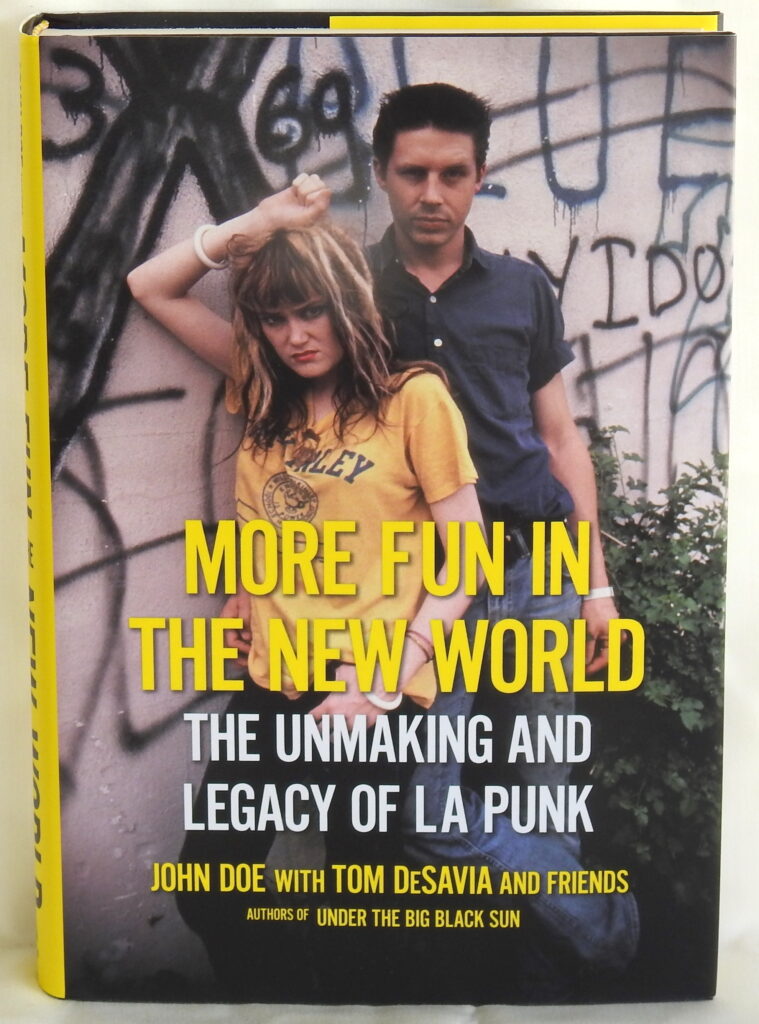
Da Capo Press, 2019
[Peter Case writing] One night I was over at Jeffrey [Lee Pierce]’s house, writing songs and drinking, and we decided to go get some more of everything up at Turner’s on the strip. We stumbled out to my car and headed to Sunset, where the light was red, so we made a right on the light, legal in California. There must have been something about us, because a sheriff’s car came up behind with the siren and lights on.
“Oh, fuck, the car’s not registered! I have tickets out, and I’m not even sure my license is current! Fuck!” I’d just come in from the road, and these aspects of unfinished business flashed through my mind. I could really get screwed here. Besides, we were both drunk, and who knew what my buddy Jeff was holding. There was no telling.
I began to pull the car over to the side. “Not there!” came the irritated and extremely stressed-out voice of the cop over his crackling loudspeaker. I continued on, nervous as hell, pulled over a hundred feet down, shut off the car, and rolled down the window. Here comes the cop, an African American man with a severe buzzcut, which almost make him look like a skinhead. His voice was shaking with anger. “What were you doing back there! Let’s see your license and registration,” he barked.
Oh, man. I handed him my ID and started fumbling around, looking for the registration, which I knew was invalid. The car was a mess. I kind of mumbled, “Not quite sure where it is.” Jeffrey opened up the glove box, and some old, unpaid traffic tickets came fluttering out and fell to the floor.
The cop looked past me. “What’s your name?”
“Jeffrey Pierce.”
The cop leans in to get a better look. “Jeffrey Lee Pierce?
“Yessir.”
The cop brightened up. “Hey, you guys are pretty good. I saw you play a couple of weeks ago over at the Music Machine. Look, you gotta watch what you’re doing on those right turns. And Jeffrey Lee, tell your friend here to take care of those tickets and registration!”
He walked back to his car, got in, and drove away.
And Jeffrey and I just sat and stared through the windshield. (205-6)
I’ll stop posting on music (for now) with this post… At a recent gathering there was a discussion about The Gun Club and I told this anecdote. I realized I hadn’t posted on the follow-up book to Under the Big Black Sun: A Personal History of L.A. Punk from several years ago. In that book, John Doe and Tom DeSavia gathered recollections from participants from the burgeoning punk scene in Los Angeles from the late ’70s until around 1982. More Fun in the New World collects thoughts from those in the LA scene, including Dave Alvin, Jane Wiedlin, Mike Ness, Maria McKee, Peter Case, Chip Kinman, and many others, focusing on 1983 – 87.
Under the Big Black Sun covered a variety of stories that captured the unifying feel of the early years of that scene, maybe a “golden age” for the genre, despite the many directions the music went from the various artists. As I wrote in the post on the end of the era covered in that book, “Accidental deaths and suicides, drug abuse, incursions by violent types, record label signings, and the music splintering into various genres (hardcore, roots, country, etc.) pulled apart the feeling of community that had developed during the frenzied growth.”
In the introduction of More Fun in the New World, Krissy Teegerstrom comments about those early years, “The first-wave pioneers had thrown seeds and that those seeds had taken root,” influencing many areas of art and literature beyond music. The inclusion of chapters in the sequel from people like Shepard Fairey, Tony Hawk, Tim Robbins, and Allison Anders highlights the spread of the era’s influence in multiple directions outside of the LA music scene.
Like the previous book, there are plenty of self-inflicted damage and casualties along the way, something that seems to be almost a given in the industry. Or maybe some of the people it attracts. There were the usual lifestyle dangers, with additional pressures coming from the commercial success of several of these bands. Nonstop touring adds to this volatile mix.
One trait highlighted in many of the writers’ stories is the generosity shown by more successful artists, providing help for newcomers that they thought showed promise. This camaraderie survived the early years despite the splintering into multiple directions. Also present in all of the stories is a gratitude for the opportunities and experiences they were able to realize. And survive.
My favorite chapter is probably the one by Pleasant Gehman relaying what it was like to live in Disgraceland, an apartment complex owned by Mickey Hargitay that became “the most infamous punk rock crash pad in Los Angeles.” She covers not just the flow of people there but also the flavor of the nearby clubs that were the mainstays of local and visiting bands. She highlights something that flew under the radar for me in the previous book: the end of the first wave of L.A. punk around 1982 began with women pulling out of the scene due to the increasing amount of violence. This second wave also ended in part due to women pulling out of the scene as well, “this time not from violence but from the rampant sexism and misogyny.”
Being a scene, many of the stories reflect what happened to L.A. punk and its offshoots happens to all scenes—they flame out or transform into something else, while a new scene develops. In this case, hair metal was the upstart, taking over the Strip and becoming the next big thing. The L.A. punk scene, though, left a mark that can be seen carrying down through the years. I enjoyed both Under the Big Black Sun and More Fun in the New World, not just for the insights of those who were in the midst of it but also to see and commiserate with others who enjoyed the scene.
[From Shepard Fairey’s chapter] L.A. punk of the eighties was far from monolithic or one dimensional. There are many things I learned observing the L.A. punk scene, including lessons in work ethic, fearlessness, self-promotion, media creation, scene building, graphic art, outspokenness, and so on. All of those things are incredibly valuable, but probably the most valuable thing I learned is that true punk is the freedom to fulfill your own vision without worrying about stylistic orthodoxy or commercial appeal. L.A. punk looked and sounded a lot of different ways, but they were all about freedom—the freedom to forge your own path, make your own sound, and say what you want to say. L.A. punk lit a fire in me, a desire for creative freedom that takes shape in every aspect of me, a desire for creative freedom that takes shape in every aspect of my life. Some people dismiss punk as an art form that burned bright and short, but I see the fires sparked by L.A. punk carried on the wind and burning bright in countless manifestations. (165)