Sonnez Les Matines by Jane Clark Scharl
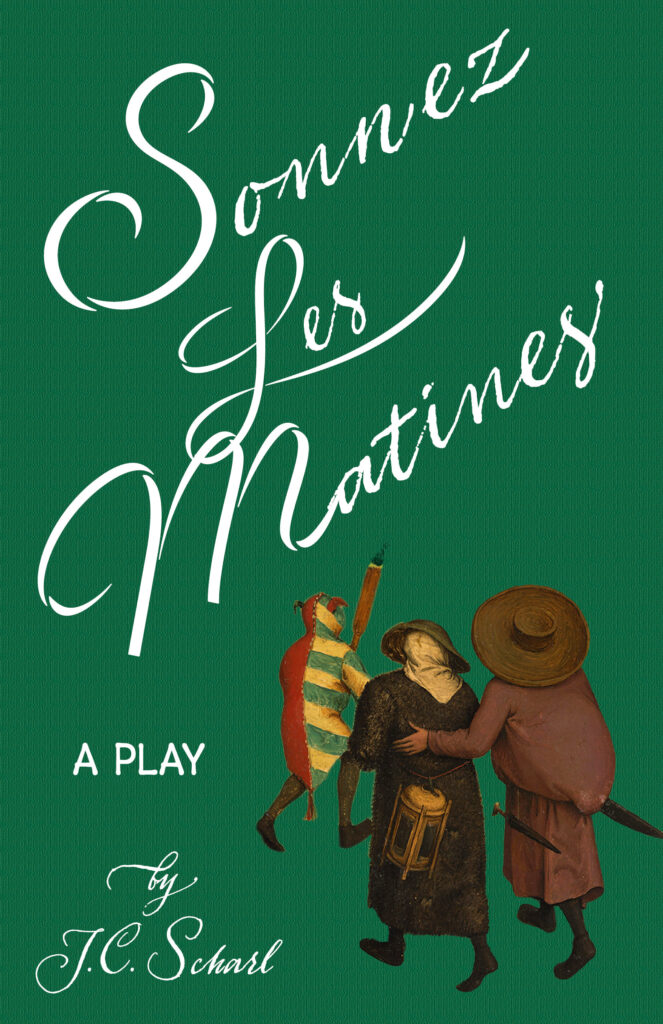
Wiseblood Books, 2023
Love Wisdom, say I, but not with what’s above!
She’s a pretty girl, and ripe; lover her
with your body, your skin and bones, the gurgle
of your gut; love her with your rutting heart.
We’re all little pigs, rooting in the dirt
after something—the slut, the priest, the lord,
magister, mother, student, tenant, doctor,
bishop, king, pope—saints and sinners
all rooting in the mud… .
(page 101)
Frère Jacques, Frère Jacques,
Dormez-vous ? Dormez-vous ?
Sonnez les matines ! Sonnez les matines !
Din, din, don. Din, din, don.
(Lyrics to Frère Jacques)
John Calvin, Ignatius of Loyola, and François Rabelais walk into a Parisian bar. No, it’s not the start of a joke but part of the storyline in the play Sonnez Les Matines, the first play in a planned Rabelais trilogy by poet and playwright Jane Clark Scharl. The second play, The Death of Rabelais, came out last fall and I’ll post on it soon.
This play is set on a late Mardi Gras evening in 1520s Paris, following what happens when those three men stumble across the body of a murdered woman and investigate her death. While the play has a tight structure, the three voices and temperaments are distinct and often at odds with each other as they cover many diverse topics. As the publisher’s page notes, “The ensuing investigation sparks a battle of wits and weapons, plunging them into questions of justice and mercy, grace and sin, innocence, guilt, love, and contempt. Before the bells ring in the start of Lent, they must confront the darkest parts of their souls and find the courage to pursue truth in a world that seems intent on obscuring it.”
John Calvin (Jean Cauvin in the play) highlights the body/soul divide as well as questions about free will. He aims “If you tended / to your soul with half the fervor / you now lavish on others’ bodies, / you truly could aspire to be / the finest saint in all Paris” at Rabelais, but he recognizes that despite his own attempts at tending his soul he carries damnation with his actions. Direct in his various examinations, he calls out sophistry from the other two. As the evening progresses his faith in divine goodness sinks and he despairs about his fate.
Ignatius’ desire for order in behavior and desires reflects his soldier background. He champions good and truth, believing in their strength and durability, while lamenting the fragility of beauty. Rabelais uses word play and wit to highlight his belief that truth lies closer to farce in our lives than to the stricter beliefs of Calvin or Ignatius. To him, “Heresy’s worthless unless it’s done full-force.” As far as anything else done halfway, whether heresy or moralizing, he believes it to be impotent philosophical posturing. He paints his “fleshy fascination” as strictly forensic, befitting his background as a doctor, but sees no need for a choice between flesh and faith. Some of the funnier parts of the play revolve around the contrast of Rabelais’ logic while the other two are mired by guilt and remorse.
The woman’s death and the three men’s attempt to figure out what happened provides not just the story’s impetus but also a mirror for them to reflect on their potential role in her demise. In addition to the questions raised in the publisher’s quote, one of the spicier relationships highlighted is that between body and soul, helped along (of course) by Rabelais’ explicit, bawdy jokes. There is plenty of wit and humor, with deeper exploration into theological and philosophical thought. As Scharl notes in the Preface, “Too often we think of these things—body and soul, feast and fast, sin and grace, death and life—as juxtaposed, existing at cross-purposes, undoing and undermining, but that is all wrong.” Her play explores the connections between these things and how they coexist in us. It’s not a comfortable conversation, but it proves a rich and humorous play.
- J C Scharl’s substack
- A post on the book in New Ohio Review by Betsy K. Brown
- A review at the Acton Institute
- Podcasts with Scharl’s comments on the book can be found at Catholic Culture and I Might Believe in Faeries
[F]or in the muck’s the stuff
of our selves: the fair, the foul, the rough,
the smooth—and all the finest jokes, of course,
come not from the smooth parts but the coarse.
The highest heights of heaven are light,
the finest hearts on earth are light;
if He who sits in heaven laughs at us,
what else can we do but laugh gratis?
And if He who sits in heaven smiles,
what can earth do but put aside her wiles
and smile too? The world is ours, the world,
the flesh, blood, and mind, all ours, all play!
This world is ours, to save, or throw away.
(page 102)