Glorious Exploits by Ferdia Lennon
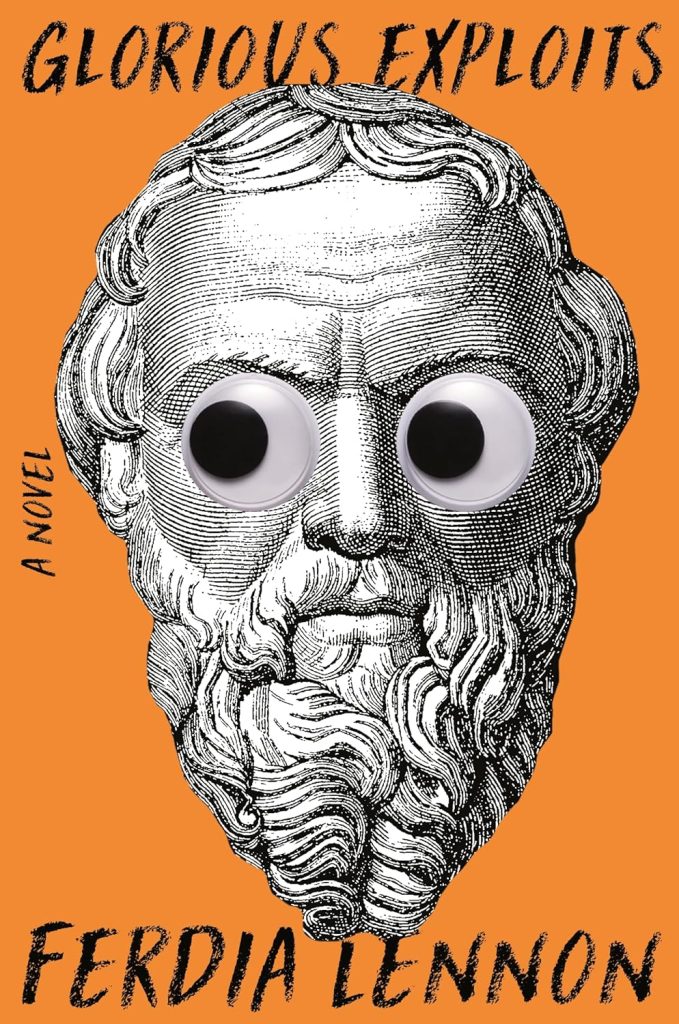
Henry Holt and Company, 2024
Most of the Athenians perished in the stone quarries of disease and evil fare, their daily rations being a pint of barley meal and a half-pint of water; but not a few were stolen away and sold into slavery, or succeeded in passing themselves off for serving men. These, when they were sold, were branded in the forehead with the mark of a horse, — yes, there were some freemen who actually suffered this indignity in addition to their servitude.
But even these were helped by their restrained and decorous bearing; some were speedily set free, and some remained with their masters in positions of honour. Some also were saved for the sake of Euripides. For the Sicilians, it would seem, more than any other Hellenes outside the home land, had a yearning fondness for his poetry. They were forever learning by heart the little specimens and morsels of it which visitors brought them from time to time, and imparting them to one another with fond delight. In the present case, at any rate, they say that many Athenians who reached home in safety greeted Euripides with affectionate hearts, and recounted to him, some that they had been set free from slavery for rehearsing what they remembered of his works; and some that when they were roaming about after the final battle they had received food and drink for singing some of his choral hymns. Surely, then, one need not wonder at the story that the Caunians, when a vessel of theirs would have put in at the harbour of Syracuse to escape pursuit by pirates, were not admitted at first, but kept outside, until, on being asked if they knew any songs of Euripides, they declared that they did indeed, and were for this reason suffered to bring their vessel safely in.
The Life of Nicias, Plutarch, translation by Bernadotte Perrin, 29
“Water and cheese,” says Gelon, “for anyone who knows lines of Euripides and can recite them! If it’s from Medea or Telephus you’ll get olives too.” …
Gelon’s mad for Euripides. It’s the main reason he comes. I think he would’ve been almost happy for the Athenians to have won if it meant Euripides would’ve popped over and put on some plays. He once spent a month’s wages to pay an old actor to come to our factory and recite scenes while we shaped pots. The foreman said it was reducing productivity, and he threw the actor out. Gelon didn’t give up, though. He had the actor shout the lines from across the street. You’d hear snatches of poetry through the blaze of the kiln, and though I think we made fewer pots that week, they were stranger, more beautiful. This was all before the war, and the actor’s dead, the factory gone. A block of cheese held over his head, shouting about olives. Gelon’s just mad. Never mind Euripides.” (Glorious Exploits, p. 7-9)
There are a lot of reviews of this book already so I thought it might be helpful to provide some extended excerpts if you weren’t familiar with the background as well as providing a taste of the novel. Not to mention, I love the idea of the pots being stranger and more beautiful if made while listening to Euripides. If you’d like a summary recap on Athens’ Sicilian expedition and some of the names you’ll see in the novel, go to Books 6 and 7 in my summary posts on Thucydides’ The Peloponnesian War.
In 415 BC during a break in the Peloponnesian War, Athens turned a request for help from a city on Sicily into a full blown attempt to invade the island. Two years later they were utterly routed, most of their forces dead or enslaved in the stone quarries near Syracuse. Ferdia Lennon takes Plutarch’s description of the Syracusans’ love of Euripides and runs with it. Lampo and Gelon are two out-of-work potters who go to the quarry to see if any of the surviving Athenians can quote lines from Euripides’ plays. They hatch a plan to use the prisoners to stage a production of Medea, later deciding to make it a double-bill by adding The Trojan Women. While you could say that hilarity ensues, so do other developments to endanger the directors’ lives and their friendship.
One theme in the book was the transformative power of theater. The prisoners cast in the play receive extra food and drink rations and not only return to some sense of their former selves but also metamorphose into true actors, at times losing themselves in their roles as best as they can in their weakened state. Lampo and Gelon, two severely damaged individuals, take on the responsibility of director and convalesce (at least in some areas). The staging of a play created by and acted by recent enemy combatants raises emotional issues for Syracusan participants and viewers, but there are moments when the art transcends such concerns. The degradation of the enemy captives and dead hits a sore spot at times, too. Gelon, when hearing a tour guide fabricate stories about Nicias’ death challenges the liar: “What’s wrong with you? You degrade a man’s suffering like that for coin. Don’t you see it’s all of us who lose?”
The heart of the book, though, is friendship, primarily that between Lampo and Gelon but not limited to them. What friends are willing to do for each other is remarkable, even when potential conflict might drive a wedge between them. It’s clear that the two love each other, often overlooking weak moments, recognizing and accepting those slips as part of who they are. Some of those moments, though, have potential to give rise to their own tragedies.
While there is a lot more to the book, I’ll touch on the issue the book raises on the impact of war on both the combatants and the populace. Examples such as the Athenian prisoners being treated as sub-human or seeing what just the mention of Hyccara’s razing does to those who carried it out show a mounting toll on both sides. The related issue of the slave trade gets highlighted, too. It’s one of the conundrums of being human that the same creators and appreciators of exquisite art can behave in such a destructive manner.
Most reviews of the book note the modern Irish language and slang Lennon uses, although I’ll have to take the reviewers word for it since I wouldn’t know. I can vouch that it sounds like modern instead of trying to mimic an ancient dialect, examples of which usually end up sounding artificial.
Something I noted, but doesn’t impact the enjoyment of the book: Gelon repeatedly refers to The Trojan Women as Euripides’ newest play despite its performance three years before the bulk of the novel takes place. The play debuted after the expedition had been approved by Athens’ assembly in 415 BC but before the soldiers left for Sicily. It is plausible Gelon thinks it is Euripides’ latest as relations between Syracuse and Athens could have prevented the Sicilians from seeing or hearing about his more recent plays. Despite Gelon proclaiming it as Euripides’ best play yet, it falls short of that claim. As Richard Lattimore puts it, the play “is nothing but an outburst, a denunciation of aggressive war and imperialism.” Combine that with the plot of Medea, though, and you have plays that would have resonated with the Syracusan audience despite being written and performed by the enemy. All in all, I enjoyed the fun romp Lennon conjured up.
“It’s poetry we’re doing,” he [Gelon] whispers. “It wouldn’t mean a thing if it were easy.” (51)
As for those in the quarries, the Syracusians handled them at first but ungently. For in this hollow place, first the sun and suffocating air (being without roof) annoyed them one way: and on the other side, the nights coming upon that heat, autumnal and cold, put them, by reason of the alteration, into strange diseases: especially doing all things, for want of room, in one and the same place; and the carcasses of such as died of their wounds, or change [of air] or other like accident, lying together there on heaps. Also the smell was intolerable: besides that they were afflicted with hunger and thirst. For eight months together, they allowed no more but to every man a cotyle of water by the day, and two cotyles of corn. And whatsoever misery is probable that men in such a place may suffer, they suffered. Some seventy days they lived thus thronged. Afterwards, retaining the Athenians, and such Sicilians and Italians as were of the army with them, they sold the rest. How many were taken in all, it is hard to say exactly: but they were seven thousand at the fewest. And this was the greatest action that happened in all this war, or at all, that we have heard of amongst the Grecians: being to the victors most glorious, and most calamitous to the vanquished. For being wholly overcome in every kind, and receiving small loss in nothing, their army, and fleet, and all [that ever they had], perished (as they use to say) with an universal destruction. Few of many returned home. And thus passed the business concerning Sicily.
The Peloponnesian War, Thucydides, translation by Thomas Hobbes, 7: 87
Links:
- The publisher’s page, with a link to the opening pages of the book
- While no episodes are currently available, BBC Radio 4 did a 10-episode adaptation of the book. I have seen old shows become available for listening again.
- YouTube videos with the author discussing the book can be found here and here
- A short interview with the author at Debutiful.net