Rome Before Rome by Philip Matyszak
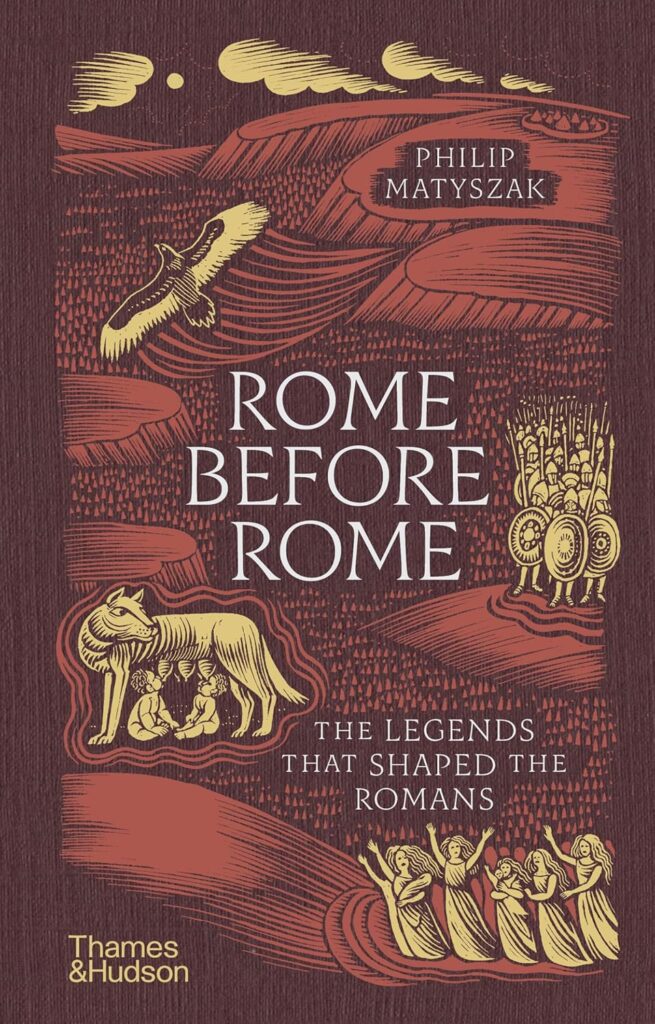
Thames & Hudson, 2025
One can learn a lot about a society from its legends—and every society has them, whether it is King Alfred burning the cakes or George Washington vandalizing cherry trees. The protagonists of these legends often embody the qualities which a society believes its best members once had, and which they should strive to have again. Likewise, the villains of these legends embody the anti-social qualities that society fears most. In short, legends are not just semi-fictional yarns from days of yore—they are the stories that tell a people who they are, what they should be and what they should fear. …
The legends of Rome are important for two reasons. The first is that the Romans strongly identified with these stories. … [Secondly,] not only can we not understand the Romans without understanding their legends, but we cannot understand Western culture either. … However, few know of how these legends fit together, and indeed fit so coherently that the early history of Rome might be best described as a concatenation of legends.
These legends told the Romans that they were brave, chaste and honourable, respectful to their gods and beloved by them. … Not all of these tales make for comfortable reading. … Like Roman history, Roman legends are not for the squeamish. The Romans were a violent people living in violent times and their legends both reflect and (to later Romans) justify this.” (from the Introduction)
Philip Matyszak has provided a good roundup of early Roman legends that provide “cracking good stories.” Many of these legends are well known, but there were some I was not familiar with. There can be varying, conflicting accounts in the legends, something Matyszak doesn’t shy away from. As he points out, these stories provide insight into how the Romans wanted to view themselves. He is spot on in noting that piecing together this early history can seem like a “concatenation of legends,” but there are repeating underlying themes. In addition to the ideas listed above, there is also a deep intertwining with Greek and Trojan legend. There are many legends of overcoming hardships, sometimes with the help of the gods, but there are setbacks, too.
Matyszak highlights two themes of Rome’s founding, calling them somewhat incompatible. These legends highlight either 1) the squalid origins, built to greatness by later generations of Romans, or 2) Rome’s greatness “ordained, promoted and protected by the gods from the beginning.” (39) I don’t see these conflicting as much as he highlights, and at least he notes they aren’t mutually exclusive. Just because the beginnings may have been squalid doesn’t mean they weren’t ordained, promoted, and protected from the beginning. What Matyszak has done, quite well, is show how all these different legends fit into one or the other (or both) of these themes.
There is a run-through of foundation stories which demonstrate acts beyond more modern acceptable bounds of convention or law. These acts could also be viewed as the defiance required in order to survive their early vulnerability to hostile enemies. Matyszak notes that the Romans believed the gods helped those who helped themselves, which to me either marks a minimizing of fate or could mean it was the cities fate to flourish—as long as the Romans did their part and not passively wait for good things to happen.
Moving on to the history and legends of the kings, Romans were mostly (but not always) victorious, usually through adept strategy, bravery, strength, and cunning. There is often emphasis on talented, upwardly mobile individuals. The legends sometimes highlight the influx of people, often outcasts from their home cities, or call attention to the flaws of celebrated figures. Since it has been lost exactly how some of Rome’s institutions, religious rituals or governmental institutions developed, legends oftentimes get “assigned” to one of the Kings in order to provide a foundational story. For example, Numa gets credit for religious rituals and Servius gets credit for certain governmental developments and civic institutions even though there isn’t detail on the how or why.
Often we run into a chicken-or-the-egg problem on origin stories, running into issues with the legends to determine if figures existed and their accompanying stories happened. For example, was there actually the person of Coriolanus and carry out what legend outlines, or was the legend invented to explain the existence of a particular temple? It doesn’t help the veracity of the stories that the surviving texts are written hundreds of years after the events portrayed. While it’s true many of the extant texts relied on earlier works, there can still be a significant time gap involved. Since most of these stories were passed on by oral tradition before being recorded in writing, it’s easy to see where deviation or embellishment over time in the tales could occur.
The legends covered end during the early days of the republic where the importance of the plebian/patrician split has reached a boiling point, especially during the two Secessions of the Plebs. To his credit, Matyszak doesn’t shy away from the darker or seamier side of Roman history (as noted in the Introduction quote).
Matyszak gathers the extant stories mainly from the writings of Dionysius of Halicarnassus, Livy, Plutarch, Polybius and Ovid, with mentions from the works of Cato the Elder, Pliny the Elder, Cicero, and Tacitus. Matyszak points out where legends conflict while also highlighting certain myths that need to be dismissed. As he points out, “Legends differ from myths and folklore in that they focus on humans in a historical setting. That historical setting is one which is generally accepted as being real.”
There are very helpful lists of Dramatis Personae, including Roman kings and consuls, nearby regions’ kings, and notable figures. Also included is a glossary of Latin terms used in the book along with a helpful bibliography for further reading. All in all a fun piece of unified storytelling pulled from multiple sources.
The Romans don’t have a single historian or chronicler from their early days, but each of their [later] historians has extracted something from the ancient accounts.” (Dionysius of Halicarnassus, Roman Antiquities, 1.73.1)
The great name of Rome is known to all mankind, but not all writers are agreed about from whom or from what circumstances the city was given its name. (Plutarch, Life of Romulus, 1.1)
The tales that come from the time before the city was founded, or from when it was about to be founded, are more poetic legends than trustworthy, verifiable history. These will not be confirmed nor refuted here. It was the privilege of ancient writers to add dignity to tales of how their city was founded by adding a dash of the divine to human affairs. And if any people are allowed to sanctify their origins by attributing them to the divine, then their military glory has qualified the Romans. (Titus Livius (Livy), From the Founding of the City, Preface)
Some sample pages, including several of the illustrations, can be found here.