Patriot: A Memoir by Alexei Navalny (updated)
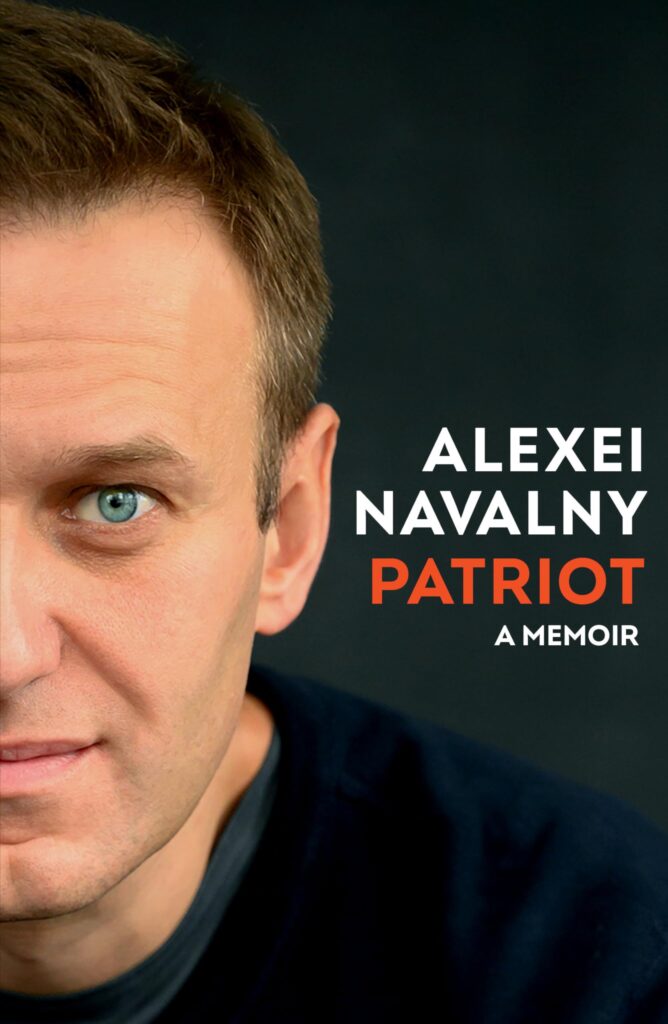
Knopf, 2024
Update: I didn’t realize my post had been made with an early draft I had made before I finished the book. I’ve added my comments on the last section of the book at the bottom of the post. It doesn’t make for a good flow, but wanted to include all the notes I wrote on the book.
If the [Russian] authorities want you to die, there are countless painful ways they can kill you, as Alexei Navalny’s death in February 2024 demonstrates. Under Vladimir Putin, Russia is gradually returning to the repression of the late Soviet era, and so one can add Navalny’s posthumous Patriot: A Memoir to the list of classics above. Is there another culture where prison memoirs are a major literary genre?
– Gary Saul Morson, “Sublime Courage,” Claremont Review of Books, Winter 2024/25 (emphasis mine)
Morson’s review linked above is for To the Success of Our Hopeless Cause: The Many Lives of the Soviet Dissident Movement by Benjamin Nathans, and also includes some notes on Patriot. Patriot‘s first chapter begins with Navalny’s near-fatal poisoning in August 2020. His wife Yulia was able to get him evacuated to Germany where he spent the next few months recuperating and beginning his memoir. In January 2021 he returned to Russia and was promptly arrested. The last 200 pages of the book are from his diaries that he was able to smuggle out of prison, covering that imprisonment up until a few days before his death.
Navalny covers his early life under Soviet communism and then his education in law, finance, and securities in the 1990’s and early 2000’s. He cautions the reader about his recollection of the dissolution of the USSR, “I’m not claiming to be a repository of objective truth, just relaying what my feelings were.” This could be said about much of his memoir, but given the number of Navalny’s supporters his thoughts and opinions must have been shared by many. It quickly became apparent that the potential of liberation from past political corruption and abuses was not to be: “[W]e have to face the fact that from the early 1990s to the 2020s, the life of the nation has been wasted moronically, a time of degeneration and failing to keep up.”
Navalny covers his political involvement and the steps taken by the state to suppress or squash his dissent movement. He was able to take advantage of the internet to raise awareness of corruption and provide a voice of opposition, benefiting from Russian officials’ lack of understanding the potential power of the medium. He was an early adopter (using LiveJournal at first as the platform for his blog) because he had no other option to find supporters. “I took to the internet because there was no alternative; television and the newspapers were censored, and rallies were banned.”
His political career was continually undermined but being removed from ballots and seeing vote-counting fraud didn’t deter him. He recognized the support he had from people despite money quickly drying up when no one in a position of power or influence wanted to be connected with him for fear of official reprisal. Out of necessity again, he turned to micro-dontaions by appealing to the public from his blog. Money came pouring in. He was able to build a business and political organization across the country, hiring people committed to publicizing the corruption in the government.
Navalny repeatedly states and acts like he could find a common language with most of the country since he was open to dialogue and discussion with everyone. His message of fighting the people in power who were seen as wrecking the country and acting in their own interests resonated with the general public. In a sense, he dared the government to arrest him since he knew his high profile and popularity would make it difficult to punish him and end up embarrassing the prosecutors more. During the opportunity to provide final words at one of his trials he notes that the judge, prosecutors, and court representatives were staring at the table in front of them, unable to look him in the eye since they knew the trial was a sham.
I am suffering under no illusions. I understand perfectly that none of you will suddenly leap up and overturn that table, nor will you say, “I’ve had enough of all this!” Neither will the representatives of Yves Rocher stand up and say, “Navalny has convinced us with his eloquent words!” People are made differently. The human consciousness compensates for the feeling of guilt; if it didn’t, people would constantly be throwing themselves onto dry land like dolphins. It’s impossible for you to go home at the end of the day and say to your children or your husband, “You know, today I took part in the sentencing of someone who was clearly innocent. Now I feel really bad about it and will always feel bad.” We don’t do that, because we’re made differently. …
Why do you put up with these lies? Why do you just stare at the table? I’m sorry if I’m dragging you into a philosophical discussion, but life’s too short to simply stare down at the table. I blinked and I’m almost forty years old. I’ll blink again and I’ll already have grandchildren. And then we all will blink again and we’ll be on our deathbeds, with our relatives all around us, and all they’ll be thinking about is, It’s about time they died and freed up this apartment. And at some point we’ll realize that nothing we did had any meaning at all, so why did we just stare at the table and say nothing? The only moments in our lives that count for anything are those when we do the right thing, when we don’t have to look down at the table but can raise our heads and look each other in the eye. Nothing else matters. (237)
He is repeatedly arrested after many of the demonstrations where he appeared, but was usually released after a short period of detention. At one point he was held to house arrest, which made him feel caged in a way that prison didn’t. Violence employed to deflate his organization failed to deter him or his followers, so things escalated up to the attempt on his life with a nerve agent. (Navalny reports that his wife may have had the same type of nerve agent used on her on a different occasion, judging by the effects she felt.) He relays the difficulty in physically recovering from his attack in fascinating detail. Far from deterred from his goals, he feels he needs to return to Russia once he has recovered in Germany. He barely makes it off the plane on home soil when he is arrested.
While Navalny is in prison his organization continues to post about the corruption of officials, getting tens of millions of views on each new post. It’s clear he was able to find others who had the same passion he did since they were able to carry on for a while after his 2021 arrest. From sources other than the book it’s easy to see that after his death the government went after many people related to Navalny’s work. His family was exiled and many of his co-workers and lawyers are either dead or hiding underground.
He notes while in jail, “I know one thing for sure: that I’m among the happiest 1 percent of people on the planet.” He shows an astonishing capacity for empathy for the guards and officials most of the time, even when they are following the silliest of rules. He muses on the routines people develop when in prison and “the amazing capacity of human beings to adapt and derive pleasure from the most trivial things” in order to survive. His compassion extends to those who betray his friendship, understanding the pressure put on them and the personal cost involved. After the 2021 arrest, he is transferred several times. Conditions deteriorate and rules become harsher with each change of prison but his compassion for guards and officials continues, even when he recognizes some of it is due to Stockholm syndrome in addition to recognizing they are also victims of the system. He begins to call prison a concentration camp on the Instagram posts he is able to smuggle out for posting. He finds his own wishes and thoughts becoming more banal the longer he spends in prison, worrying less about philosophical and political questions but focused more on his coffee, his physical pains, and his routine.
Predictably, his Instagram posts triggers new charges of terrorism, extremism, and “rehabilitated Nazism” all while still imprisoned, causing him to be placed in solitary confinement. Maybe worse is when they put a psycho (his word) in the cell across from him. “The Russian prison system, the Federal Penitentiary Service, is run by a collection of perverts. Everything in their system has a sick twist. … Everything you read about the horrors and fascist crimes of our prison system is true. There’s just one correction needed: the reality is even worse.”
I don’t know how my life is going to pan out, and trying to make sense of that is pure speculation. There are two opposing points of view. Half the people think that because they’ve already tried once to kill me, they’ll carry it through to the end. … The other half—including me—thinks that after the unsuccessful attempt to kill me and our investigation of it, they would prefer to keep their distance. …
Our country deserves better. The Russian people could live lives that are twenty times richer than they are. …
I hate Putin because he has stolen the last twenty years from Russia. These could have been incredible years, the sort of period that we’ve never had in our history. We had no enemies. We had peace on all our borders. The price of oil, gas, and our other natural resources was incredibly high. We earned huge amounts from our exports. Putin could have used these years to turn Russia into a prosperous country. All of us could have lived better.
Instead, twenty million people live below the poverty line. Part of the money Putin and his cronies simply stole; part of it was squandered. They did nothing good for our country, and that is their worst crime against our children and the country’s future. …
My story will continue, but whatever happens to me and my friends and allies in opposition, Russia has every possibility of becoming a prosperous, democratic country. This sinister regime, based on lies and corruption, is doomed. Dreams can become reality.
The future is ours. (272 – 276)
Despite being in what he calls a hellhole, Navalny sums up why he is able to withstand the mistreatment, beginning with, “Life works in such a way that social progress and a better future can only be achieved if a certain number of people are willing to pay the price for their right to have their own beliefs.” He notes there are others having a much harder time than he is in fighting for the same goal. It’s amazing to read how upbeat he is in spite of what he is going through. His final prison diary entry ends with his discussion of those in power in Russia: “The Putinist state is not sustainable. One day, we will look at it, and it won’t be there. Victory is inevitable. But for now, we must not give up, and we must stand by our beliefs.”
Yes, it’s a prison memoir but as Morson points out in his article, Navalny treats much of his experience as “absurdist comedy rather than reality,” more Gogol than Solzhenitsyn. Yet all of it was something he felt compelled to do despite the danger: “I have always tried to ignore the idea that I could be attacked, arrested, or even killed. It’s not that I’m trying not to think about it, closing my eyes and pretending the danger does not exist. But one day I simply made the decision not to be afraid.”
I end with a link to a scene from the movie Navalny in which Alexei and the filmmaking crew get a high ranking Russian official to provide details about the nerve agent attack on Navalny’s life which confirms government involvement. I haven’t seen the movie beyond a few clips, but I intend to watch it soon. (In trying to embed the video I keep getting error messages, so I’ll provide the link. It’s a very entertaining eleven minutes.)
Updated notes:
Part Two of the book (about two-fifth’s of the total) is the actual prison diary and Instagram posts made through smuggled out messages. The section starts out slow and repetitive as Navalny relays his prison routine. It is revealing to see what he had to do to stay engaged with life and how simple pleasures became important in preserving his perspective. Also interesting is how he treats those that are guarding and tormenting him, often with kindness and pity, realizing they are just doing their job in a distorted system. He relays his amusement as he continues to receive new charges and convictions of criminal behavior behind bars and marvels at the depravity in the prison system. And he frequently recognizes and thanks those that help him behind the scenes.
He notes there have been enough prison diaries published and hope this won’t be just another one. In analyzing the system he has to deal with he helps it become more than just that. He notes the question he gets most often is why he returned to Russia when he knew he would be jailed (at best) or killed. His reasons often boil down to what he has: “my country and my convictions.” Not wanting to give up or betray either, he felt he had no choice but to return. In not bowing to those in power he hoped to set an example for others not to kneel to the perversion of power. He realizes not everyone is prepared to sacrifice for their beliefs, which means they aren’t really convictions or principles, but that they still pay a price for going counter to those beliefs.
Near the end of the book he lays out “Fifteen theses of a Russian citizen who desires the best for his country.” The focus starts with the invasion of Ukraine by Russian troops but expands to address the forces behind such a decision and maps out where he believes the country should head in its development.
I wish I had could have worked these notes into the post originally, but I wanted to include all my notes even if it makes the post stilted.