Tastes and Traditions: A Journey through Menu History by Nathalie Cooke
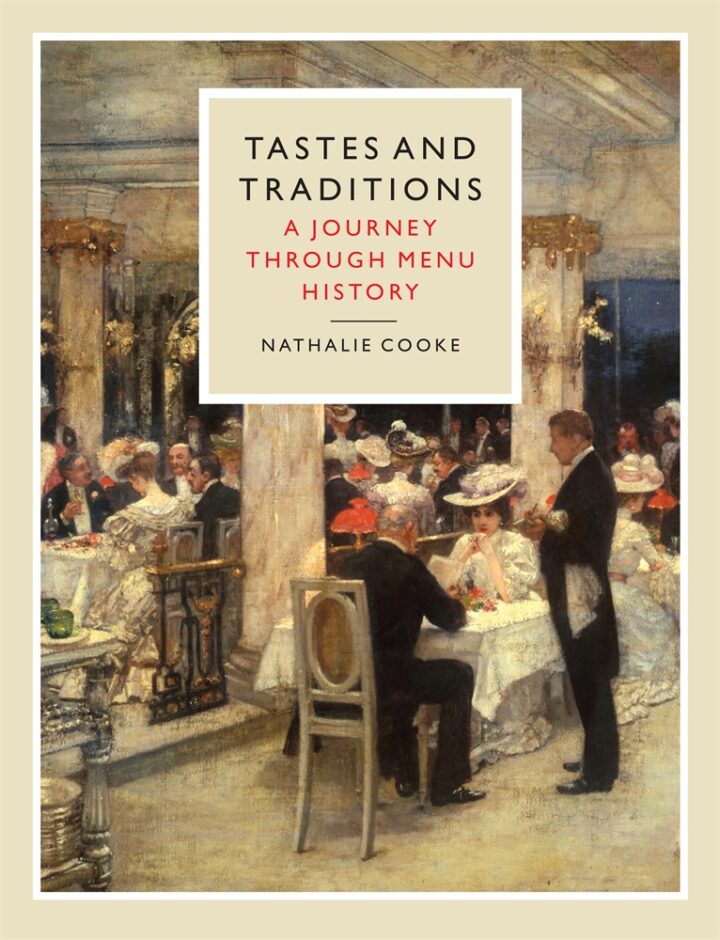
Reaktion Books, 2025
Menus, by definition, promise to serve as guides for diners, presenting or at times clarifying food choices. But in Tastes and Traditions I have argued that menus are also—and even more so—strategic documents: they shape diners’ choices, guide diners towards particular decisions and enhance their dining experiences. … This exploration was driven by four central questions. What is a menu? What does it contain? What does it do? And why does it matter? (page 165)
Restaurant menus are strategic documents, not just a bill of fare. They can be viewed as historical documents, pieces of art in themselves, and/or explore various themes. In this book, Nathalie Cooke looks at menus from different perspectives and explores some of their evolution as well as delving into various themes they have offered. A menu can be what the diner makes of it, whether it be from a straight-forward listing or a kids’ menu or a list of riddles for the diner to solve.
Menus throughout the recent centuries and many countries are presented, allowing us to see trends and innovations made along the way as well as changing norms and tastes. Most recently that includes the use of QR codes during Covid reopening, saving on printing costs, too, and a menu solely made up of emojis. Cooke includes menus for royals as well as print-outs for prisoners on their daily fare. The illustrations are lavish, although some of the examples are too small to fully enjoy or appreciate. Several menus with artistic designs are included, such as one for a feast for Louis XV or examples by Henri de Toulouse-Lautrec.
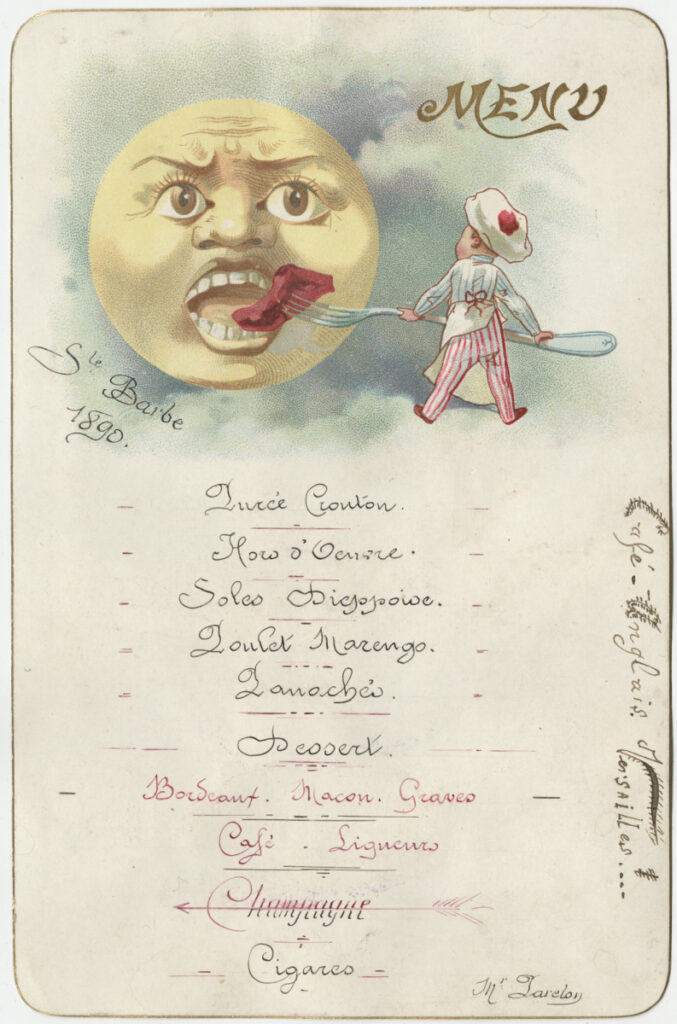
Bohn-Bettoni Menu Collection, University of Nevada
Picture source
Most poignant is the discussion about inmates in concentration camps listing unattainable ingredients to make imaginary dishes or recalling recipes from normal life while being starved to death. (Examples of the latter can be found in Memory’s Kitchen: A Legacy from the Women of Terezin, collected by Cara de Silva, English translation by Bianca Steiner Brown).
Restaurants have long been using menus as advertising, whether it’s simply posted for many to see or intended as souvenirs. Collectors have been saving menus, whether for memento value or just in appreciation of them. Many collections have been scanned and put online, such as those at the Culinary Institute of America site (such as here and here) and as part of the digital collections at the New York Public Library.
I stumbled across this book at our local public library and it made for a fun read, as well as expanding the way I look at menus when I go out now.
Videos:
- The origins of the restaurant menu: An Interview with Professor Nathalie Cooke
- Nathalie Cooke talks about Tastes and Traditions, with Mallory Cerkleski on Food as Relationship Building
An engaging exploration of why menus matter and the stories they tell.
Menus are invaluable snapshots of the food consumed at specific moments in time and place. Tastes and Traditions: A Journey through Menu History provides glimpses into the meals enjoyed by royalty and rogues, and by those celebrating special occasions or sampling new culinary sensations. It describes food prepared for the great and the good, meals served during sieges and tablescapes immortalized in art. It explores how menus entertain adults, link food with play for children, reflect changing notions of health and highlight the enduring human need to make meals meaningful. Lavishly illustrated, this book offers an engaging exploration of why menus matter and the stories they tell, appealing to food lovers and general readers, as well as professionals in the food industry.
(from the publisher’s page)
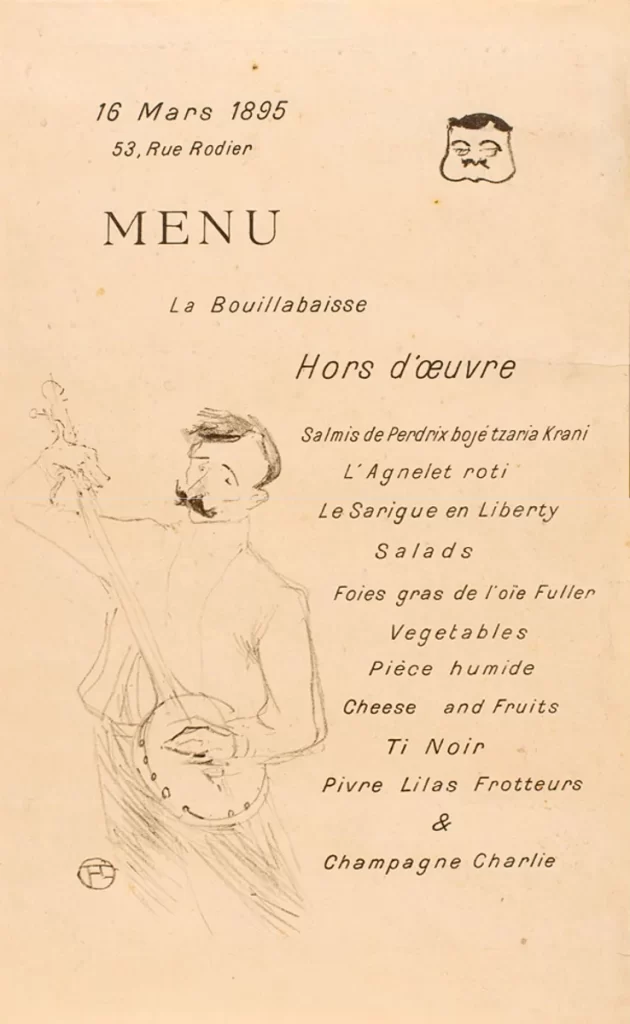
Henri de Toulouse-Lautrec, 1895
Picture source