The Death of Rabelais by Jane Clark Scharl
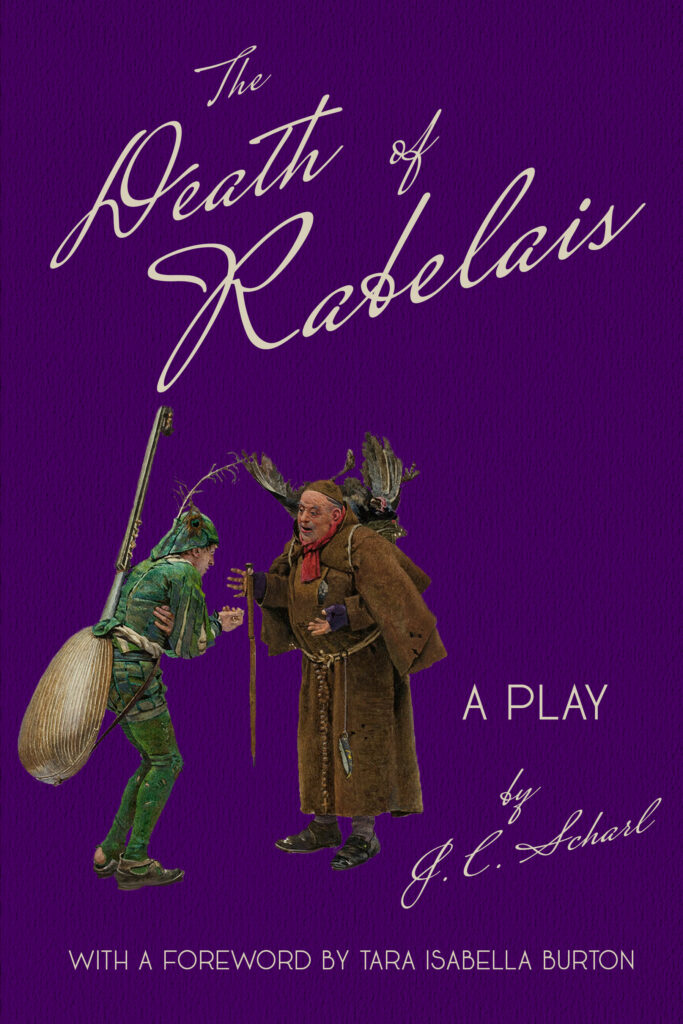
Wiseblood Books, 2025
Friar: Humor’s a relief! It shows the truth.
Every Laugh’s a window on the void—
crack jokes with me, and by them crack the world’s
facade to show the bedlam underneath!
…
Rabelais: Humor is no chaos, but the very
drip and flow of everything, the sticky
fluid carrying life up from stodgy
soil to all these many moistening bodies…
humor is our unity, our scope,
our element, our one and only hope
to make disjointed things one whole; to weave
from severed threads a spread ‘neath which to cleave
and there conceive, with giggles and with wiggles,
an unimagined jest; to nimbly wriggle
past the facts of life to breathe its farts
and still to hug it close—now that is art! (17-18)
This is the second play in J.C. Scharl’s planned Rabelais trilogy, the first being Sonnez Les Matines. In a sense, this play is another mystery but instead of a “whodunnit” like the first one it examines what constitutes life and how death can be defeated. While the year is not specified, it seems to take place several years after the initial one since he is escaping heresy charges in Paris. Rabelais seems more balanced and restrained here than in Sonnez Les Matines, his comments having even more depth behind their surface humor.
The play opens on the eve of Epiphany, a celebration of the revelation of the Incarnation. Rabelais tramps through the snow of the Champagne region wearing a cape and cap akin to that of a jester’s outfit. He meets an old friend, a Friar who out-bawdies Rabelais, and a young woman who turns out to be Death incarnate. As the storm increases the three head to a nearby house where friends of the Friar are having a celebration. Before arriving there, Rabelais and Death exchange costumes while Death (without revealing herself) states that she is to take a soul before the night is through.
It turns out there are complicated love triangles among the Friar’s friends, who all seem to be a little on edge from the weather sabotaging their revelry plans or from their thwarted longings. To put things back on track, Rabelais is tasked with directing a play. Because of the romantic drama between characters, we often end up with a play within a play within the play. While the framework of Rabelais’ play is a Job-like trial overseen by God and the Devil, there are many references and illusions to other works including several of Shakespeare’s plays and Paradise Lost.
The Friar, playing the Devil, delivers many Milton-like lines in his castigation of God and Heaven as the play raises many theological questions that go beyond the theoretical to the practical (although there aren’t any definitive answers provided to these questions). The play, as it considers what comprises Life and Death, breaks down before it finishes. The players provide differing approaches in trying to answer those questions and, as always, Rabelais will have the last word.
To cap off the evening Death introduces a game for them to play, showing there may be things worse than (or at least as bad as) death. While Death doesn’t have many lines, she provides some of the best, such as “I tell all truth straight, / and that remains always its best disguise.” Death makes it clear several times that she is only doing as directed, but who is doing the directing is not explicitly stated. Her comments at times, even when wrong, have layers of significance such as when she ‘mistakenly’ compares their Epiphany feast to Passover. She gets what she was sent to obtain but, tying in with the holiday, in a sense she is defeated by the sacrifice involved.
Death and laughter may not the obvious companions Rabelais declares they are, but by exploring
Rabelais: And yet upon this night Death laughed. Forget
everything in life but that: Death,
upon Epiphany, found mirth. The depth
of that’s unknown, the import, and the scope—
but maybe after all there’s room for hope
that as Christ, the Laughter of the Father,
took laughter down to death, he made them brothers,
and raising one, he equal raised the other,
so even as he bears to God the marks
of death, he leaves in death the very sparks
of merriment! …
I have looked on Death
and laughed, and when I come to my last breath
I’ll greet her there, if not as friend, at least
as fellow stranger at this antic feast,
and when my pardoning priest whispers amen,
I’ll dare to frolic with her once again! (162-163)
- Podcast with Scharl’s comments on the book can be found at I Might Believe in Faeries (Spotify link)
Michael Williams
Very helpful article! I’ve bookmarked this for future reference. Well done and thanks for sharing. (ref:0464a1d0d002)